Why write historical fiction?


As a voracious reader, I’ve always been more a fiction lover than a nonfiction one. English was my favorite subject in school, not history. I’ll choose an art museum over a history museum any day. Somewhere along the line, though, I began to realize that it wasn’t the history I didn’t enjoy, it was the format. The biggest problem with history is that it’s in the past; it’s dead and buried, and as a result, we can only see fragments of what once was whole and robust. Tombs don’t talk.
With historical fiction, we can resurrect personalities, events, and entire cultures, bringing them back to life. We can get inside the minds and hearts of people we’ll never meet, exploring their motivations and their passions, the things that drove them to make the choices they made. This is especially powerful when we delve into the lives of individuals who were marginalized in their time, whether because of class, gender, or some other factor. Historical fiction allows us to tell their story as it’s never been told before.
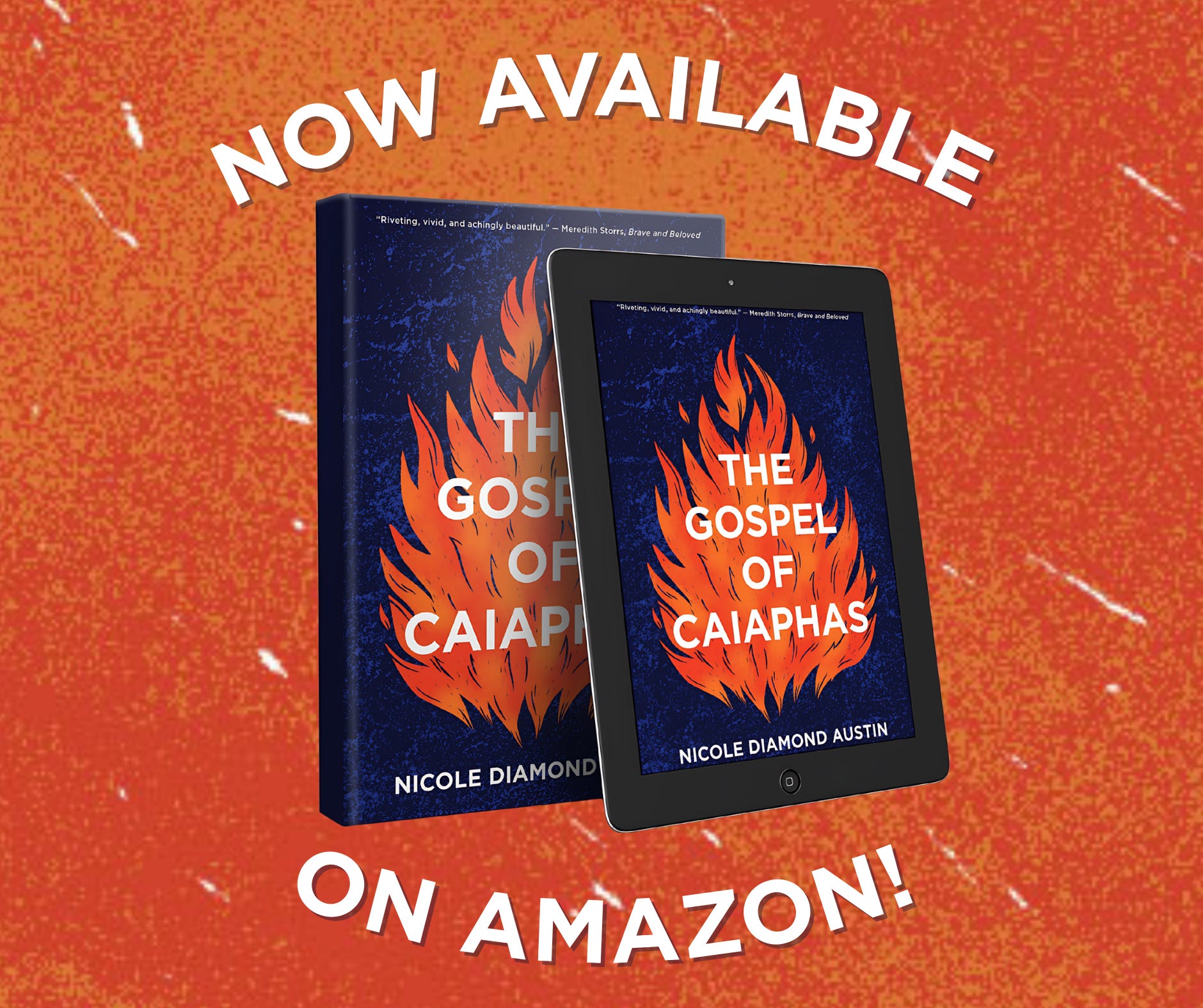
When writing The Gospel of Caiaphas, I was able to create a childhood for my main character. We know almost nothing about Joseph’s parents, which gave me the freedom to bring Hadassah and Abel to life with minimal restrictions other than those imposed by the period itself. Hadassah is somewhat of a tribute to my father’s mother; her devout Jewish faith, her physical challenges, even some of her dialogue is inspired by my grandmother. While her ability to provide for Joseph, an only child just like my father, is limited in many ways, she is immeasurably proud of the man he becomes. Pulling from my own family history helped bring this character vividly to life. This is what historical fiction can do.
During the early stages of my research for The Gospel of Caiaphas, I read a fantastic book called Once Upon a Time It Was Now: The Art and Craft of Writing Historical Fiction by James Alexander Thom. Sadly, Thom passed away in 2023, and I’m sorry I never got to write him and let him know how powerful and helpful this book was for me (highly recommend!). In reading the book, I was reintroduced to a brilliant word: verisimilitude. Verisimilitude, which comes for the Latin for “true” and “like,” means the appearance of being true or real. It’s sometimes described as “truthlikeness.” The application for writing historical fiction is that a book for a modern audience set in a former time period needs to feel real to the readers, regardless of whether the details are true.
Sometimes, a true detail will feel false to a modern reader. British author Nicola Cornick called this the Tiffany Effect. Apparently, the name Tiffany (or Tifinie) was common in the Middle Ages in England and France. However, because of our modern associations (especially with a certain 80s pop star), the name feels extremely modern. If I were to write a historical novel set in the 1500s and called my main character Tiffany, a contemporary reader might be taken out of the story, finding it inauthentic and awkward, despite its historical veracity. It’s a fascinating tightrope to walk.
Other times, we must bend what we know slightly for the sake of the narrative. With The Gospel of Caiaphas, I’ve been careful to religiously (no pun intended) maintain the integrity of the facts we know from both Biblical and extra-biblical sources. But there are times in the novel where I chose to ignore things we know to be true. For example, there is at least one moment in the novel where my Jewish characters eat food or drink offered to them by a Roman host. This would likely not have been done, and in fact, there are times during the novel where they refuse (especially while in Jerusalem or during religious festivals). But I chose to have one of my Roman characters offer food and drink to Caiaphas and his fellow travelers while away from home, both to move the narrative forward and because it felt consistent with the Roman’s character. My readers will have to decide for themselves whether it provides the appearance of verisimilitude within the context of the novel.
Historical fiction allows us to walk in the shoes of people who lived generations before us. In The Gospel of Caiaphas, I wanted my readers to experience the landscape, topography, geography, and architecture of first century Judea as much as possible. This required poring over old maps, images of archeological ruins, video of the region, and much more. I researched what plants and flowers would have grown in what seasons, what trees were native to different parts of the territory covered in the novel, what roads existed in the first century (more on the process of making the front matter maps in a later blog). I made sure when my characters stood on one of the walls of the temple that I could envision the exact view. My favorite part was figuring out how long it would take for characters to travel from place to place. Reworking modern distances for walking, considering travel conditions and the need for food and sleep, helped make me feel as if I were walking alongside them.
At the end of the day, a work of historical fiction is only as good as the story it tells. The Gospel of Caiaphas sheds light on a particular time period, and hopefully the details help to bring that time period to life. But what should linger long after the last page is the people, the hearts and souls of those who inhabited the world. I want my readers to care for Joseph, to adore Rivkah, to weep for Hadassah. I want them to have a favorite son of Annas, to root for at least one of the romances. In the last few days, I’ve received a text from a friend saying she woke up thinking about Joseph, and a message from another friend who’s cried three times so far while reading. This is why I write historical fiction.